
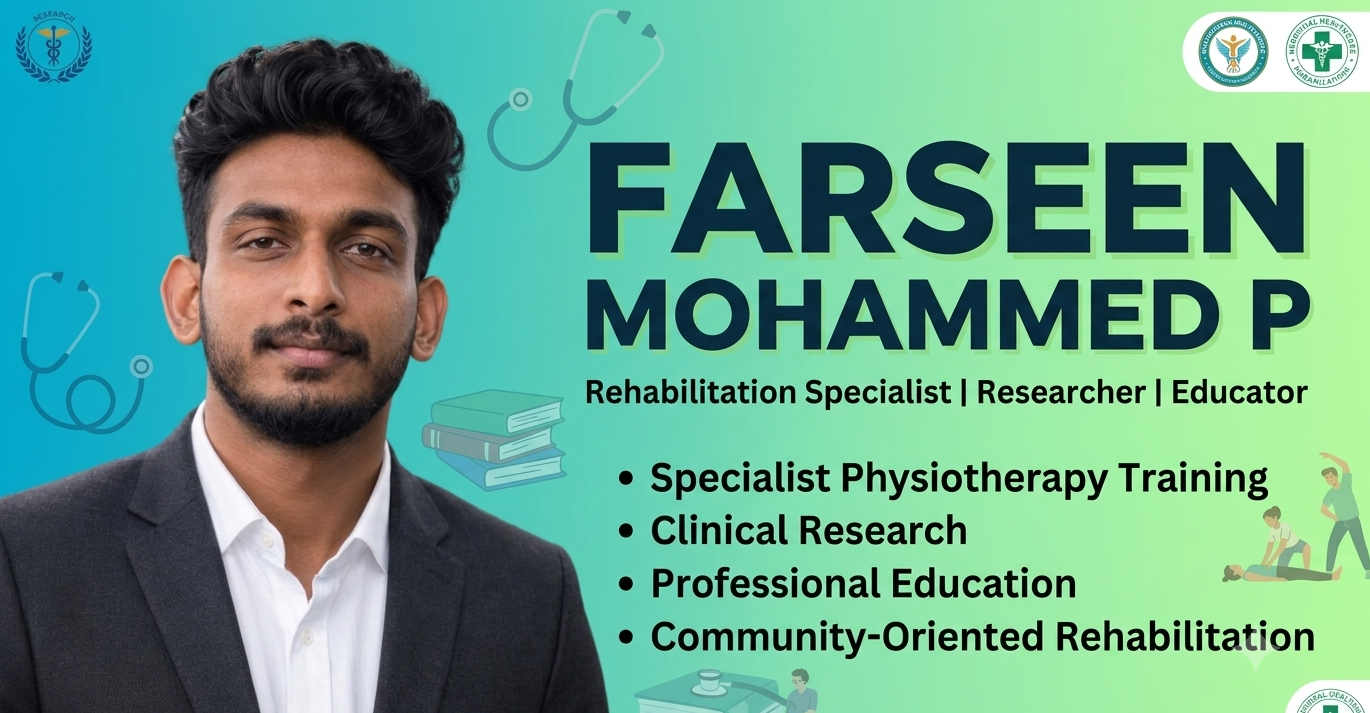
Mangaluru, Karnataka / Malappuram, Kerala: Neurological disorders can significantly affect movement, balance, strength, coordination and functional independence, making specialized rehabilitation an important component of patient care. Physiotherapist and clinical researcher Farseen Mohammed P has developed his professional focus around neuroscience physiotherapy and neurorehabilitation, combining postgraduate education with clinical training and research activities.
Farseen’s academic and professional interests include stroke rehabilitation, Parkinson’s disease rehabilitation, traumatic brain injury rehabilitation, spinal cord disorders and therapeutic exercise.
Postgraduate Specialization in Neurosciences
Farseen completed his Master of Physiotherapy in Neurosciences at Yenepoya Physiotherapy College, Yenepoya (Deemed to be University), Mangaluru, with specialization in neurophysiotherapy and neurorehabilitation.
His postgraduate education provided focused exposure to neurological rehabilitation and helped shape his interest in clinical research.
The specialization also complemented his earlier Bachelor of Physiotherapy education from the Co-operative Institute of Health Sciences, Thalassery, affiliated with Kerala University of Health Sciences.
Clinical Training in Neurological Rehabilitation
During his postgraduate clinical training at Yenepoya Medical College Hospital, Mangaluru, from 2024 to 2026, Farseen gained clinical exposure to a range of neurological conditions.
His training included rehabilitation experience involving:
- Stroke
- Parkinson’s disease
- Traumatic brain injury
- Guillain–Barré syndrome
- Spinal cord disorders
This clinical exposure provided an opportunity to understand different neurological rehabilitation requirements and functional challenges.
Neurorehabilitation Approaches
Farseen’s postgraduate clinical training included exposure to rehabilitation approaches such as Neurodevelopmental Treatment (NDT), the Motor Relearning Programme and task-oriented training.
These approaches are commonly associated with rehabilitation aimed at improving movement, functional performance and participation following neurological conditions.
His professional interests also include therapeutic exercise and exercise-based rehabilitation.
Research Interest in Stroke Rehabilitation
Stroke rehabilitation represents one of the major areas within Farseen’s clinical and research interests.
His postgraduate dissertation examined the effect of eccentric versus concentric strengthening on functional mobility in subacute stroke patients.
The research question connects therapeutic exercise with functional mobility following stroke.
His continuing research interest in this area subsequently expanded toward evidence synthesis, including a systematic review concerning the effectiveness of eccentric strengthening interventions on functional outcomes in adults after stroke.
Parkinson’s Disease Rehabilitation
Farseen’s neuroscience-focused research also includes Parkinson’s disease.
He contributed to a scoping review examining timing of dopaminergic medication relative to physiotherapy delivery in adults with Parkinson’s disease.
The study was published in the International Journal of Drug Delivery Technology in 2026, with Farseen listed as second author and corresponding author.
The research reflects his interest in questions that connect neurological medication management with physiotherapy delivery.
Continuing Professional Education
Farseen has undertaken additional training related to neurological rehabilitation.
His professional development includes training in the NDT Framework for Functional Improvement of Cerebral Palsy and Neuromotor Disorders, as well as training in the Motor Relearning Program in Stroke Rehabilitation.
He has also participated in workshops and seminars addressing stroke management and hand rehabilitation following stroke.
These activities have complemented his formal postgraduate specialization.
Therapeutic Exercise as Part of Rehabilitation
Therapeutic exercise is another important component of Farseen’s professional interests.
His academic research has examined strengthening interventions in stroke rehabilitation, while his broader research interests include exercise-based rehabilitation across different clinical populations.
This interest extends beyond neurological physiotherapy into areas such as cardiac rehabilitation and metabolic health research.
The focus reflects an interest in examining exercise not simply as a physical activity but as a structured component of rehabilitation research.
Combining Clinical Practice and Research
A defining feature of Farseen’s developing professional profile is the combination of clinical education and research.
His clinical training provides exposure to neurological rehabilitation, while his research activities involve systematic reviews, scoping reviews and clinical intervention research.
This combination allows clinical questions to become potential subjects for structured academic investigation.
His research-methodology development has also included training in systematic review and meta-analysis.
Scientific Presentations
Farseen has presented neuroscience-related research at professional physiotherapy conferences.
At Mangalore PhysioCon 2026, he presented his postgraduate research on eccentric versus concentric strengthening and functional mobility in subacute stroke patients in the postgraduate oral paper category.
He also presented a systematic review on eccentric strengthening interventions in stroke rehabilitation at SYNERGOS 2026, where he received the first prize in the postgraduate oral paper presentation category.
These presentations have contributed to his experience in communicating rehabilitation research to professional audiences.
Broader Neurorehabilitation Interests
While stroke and Parkinson’s disease are prominent areas of his research portfolio, Farseen’s clinical exposure covers a wider range of neurological disorders.
His postgraduate training included experience with traumatic brain injury, Guillain–Barré syndrome and spinal cord disorders.
His professional interests therefore encompass several aspects of neuroscience physiotherapy and rehabilitation.
A Research-Oriented Approach to Neuroscience Physiotherapy
Modern neurorehabilitation increasingly involves integration between clinical knowledge and scientific evidence.
Farseen’s academic development reflects this connection through his postgraduate specialization, clinical exposure, research projects and continuing professional education.
His interest in evidence-based physiotherapy and evidence synthesis further supports his research-oriented approach to neurological rehabilitation.
Looking Ahead
Farseen Mohammed P continues to develop his professional profile across neuroscience physiotherapy, neurorehabilitation and clinical research.
His work combines specialized postgraduate education with clinical training and academic research, particularly in areas such as stroke rehabilitation, Parkinson’s disease and therapeutic exercise.
As his research portfolio develops, neuroscience physiotherapy remains a central part of his professional identity, providing a foundation for continued exploration of evidence-based rehabilitation and clinical research.