
With organizations increasingly communicating across linguistic communities, the demand for professional Urdu Translation Services in India remains relevant across legal documentation, education, healthcare, publishing, public communication and business operations. Urdu is used by communities in several parts of the country, making accurate translation an important consideration for organizations that need to share information with Urdu-speaking audiences.
Translating content into Urdu requires more than converting words from one language to another. Its distinctive script, sentence structure, vocabulary and writing conventions require linguistic expertise and careful attention to context. For businesses and institutions, a well-translated document can help communicate information clearly while preserving the meaning and purpose of the original material.
Urdu Translation for Business and Official Documents
Companies operating across different regions may require Urdu translations of business proposals, company profiles, product information, agreements, employee communication and customer-facing materials. These translations can support organizations working with Urdu-speaking clients, partners, employees and local communities.
Official and personal documents are another important area. Depending on the purpose, individuals may need translations of educational certificates, birth certificates, marriage certificates, affidavits, identity documents or other records. The receiving institution determines whether a certified translation, notarization or additional authentication is necessary. Requirements should therefore be confirmed before submitting translated documents to an authority.
Accuracy is particularly important when translating names, dates, addresses, legal clauses and official terminology. Even a small discrepancy can create confusion or delay the processing of an application.
Legal, Medical and Technical Translation Requirements
Specialized documents demand subject knowledge as well as language proficiency. Legal translation may involve contracts, court-related documents, declarations and agreements, where the intended legal meaning must remain consistent with the source text.
In healthcare, Urdu translation may be needed for patient information, medical reports, consent forms, health awareness materials and treatment instructions. Such content requires careful terminology management because unclear wording can affect how readers understand important information.
Technical translation can cover product manuals, operating instructions, safety documentation, training materials and engineering content. Translators must preserve technical details and follow consistent terminology throughout the document. Where the subject is highly specialized, an appropriate review process can help verify accuracy before delivery.
Urdu Website Translation and Digital Localization
Digital communication has created additional opportunities for organizations to reach audiences in their preferred languages. Websites, mobile applications, online learning platforms, e-commerce pages, advertisements and social media campaigns may all require Urdu translation or localization.
Urdu uses a right-to-left writing system, so digital localization may also involve interface alignment, text display, font compatibility and layout testing. A translation that is linguistically correct may still create a poor user experience if the website or application does not display the script properly.
Organizations should therefore consider both language quality and technical implementation when preparing Urdu-language digital content. Consistent terminology and natural phrasing can also help make information easier to understand across different devices and platforms.
Preserving Meaning, Tone and Cultural Context
Urdu content can vary significantly depending on its audience and purpose. A formal legal document requires a different register from a public awareness campaign, a literary publication or a marketing message. Translators need to recognize these differences and select vocabulary that reflects the intended tone.
The source language also matters. Urdu translation projects may involve English, Hindi and other Indian or international languages. Depending on the material, the translator may need to resolve differences in idiom, technical vocabulary, sentence structure and cultural references rather than rely on literal translation.
Proofreading and terminology checks help maintain consistency, especially when a project contains multiple documents or is updated over time. For sensitive or specialized content, subject-matter review may provide an additional level of quality assurance.
Confidentiality and Quality Control
Documents submitted for translation can contain personal, financial, legal or commercial information. Organizations should consider how a service provider receives, stores, accesses and handles these files. Clear confidentiality procedures are particularly important for sensitive records and business agreements.
A dependable workflow may include an initial assessment of the source material, assignment to a suitable linguist, translation, proofreading, formatting checks and final review. The precise process depends on the document type, language pair, deadline and intended use.
Machine translation and AI-assisted tools may help with selected tasks, but content involving legal obligations, medical information or other high-impact decisions can require qualified human review. The final approach should prioritize meaning, accuracy and suitability for the intended audience.
Supporting Multilingual Communication Across India
As organizations serve increasingly diverse audiences, Urdu translation can help make information more accessible across business, public services, education, healthcare and digital communication. Selecting a provider with relevant language expertise and a clear quality-control process can help reduce ambiguity and improve the usability of translated content.
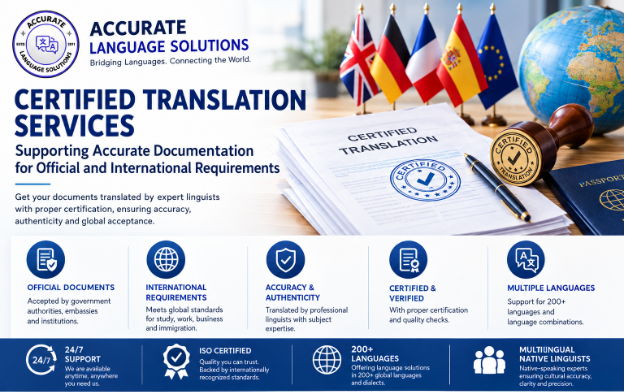
Accurate Language Solutions Private Limited offers multilingual language services, including translation, localization, interpretation, transcription and voice-over solutions. Organizations seeking Urdu translation or support for other Indian and international languages can explore its services at https://accuratelangsols.com/.
Professional Urdu translation continues to serve an important role in connecting people and organizations through clear, contextually appropriate communication. Whether the requirement involves an official document, a technical manual or digital content, the objective remains the same: to convey the original message accurately and make it understandable to its intended readers.